Self-Portrait as a Warrior
Video Installation. Video Projector, Perspex and Nylon strings. Dimensions: 80x90x45cm.
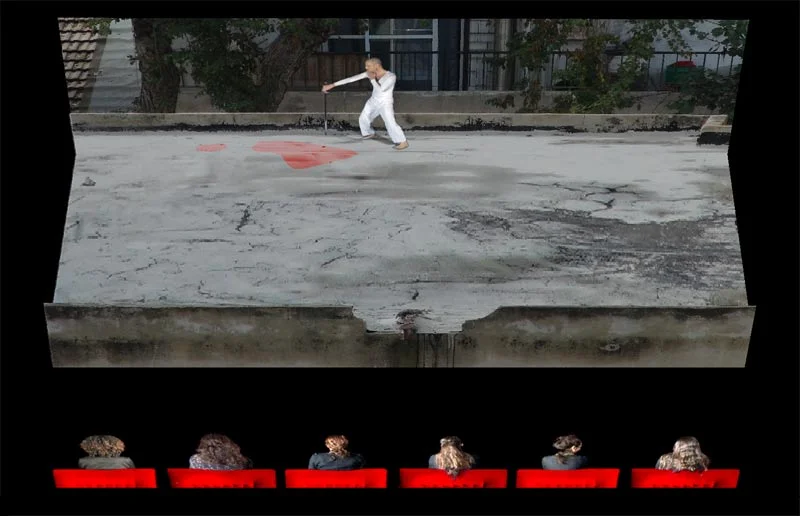
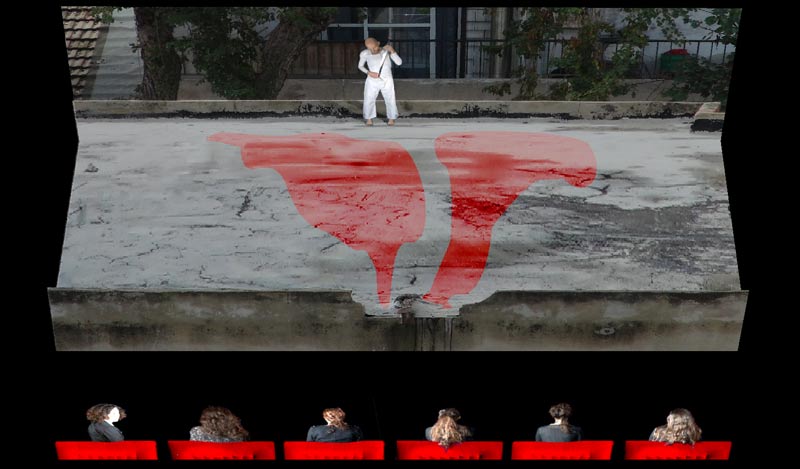
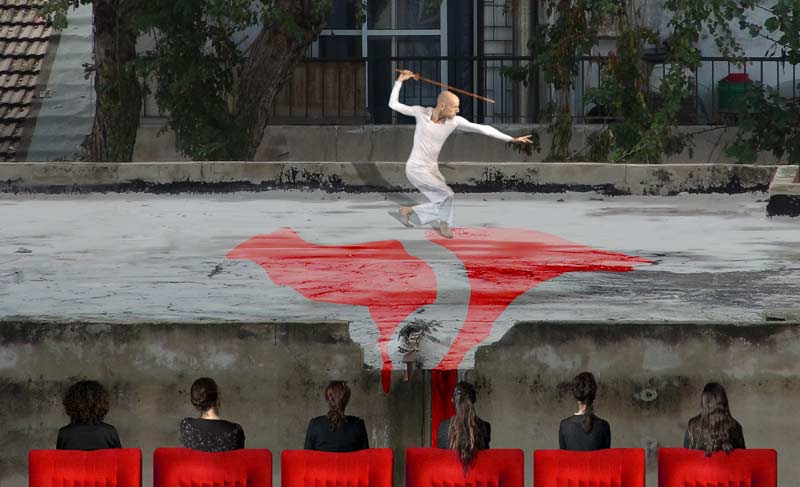
A video is projected on a perspex sculpture hanging from the ceiling.
The sound includes Harp and text. Harp composed by Adaya Godlevky and text inspired by Hamlet from Shakespeare and The Method Acting by Stanislavsky
Video Documentation of the Installation "Self-Portrait as a Warrior" - 2012
Video Projected on Perspex
Duration of Original video Work: 5min57sec
Good Enough Death - Haifa Museum of Art
The curtain rises.
The warrior gripping a dagger is situated on top of a flat concrete roof. His movements are slow and stylized. As if he where in a dream, he moves and takes on the leading role in a violent dance between a ghost and himself. His sword attempts to penetrate the flesh of the imagined.
Six women dressed in black gaze towards the battle sight, towards the artist clothed in white.
The ghost is drenched with blood. The piece “Self Portrait as a warrior” is projected onto the surface of a miniaturized sculpture. This juxtaposition enables a reciprocal dynamic between a play and the space, a relationship in which the viewer comes into being as “the seer”, and the piece in exchange, is reborn as ”that which is seen”.
A reflexive entrapment: We envelope ourselves with a social mask, staring at the women who are observing the artist seeking a fight. In a stolen moment of empathy, the blood isn't just the blood spilled across the stage. Our gaze is entangled within the gaze of the women, as we mourn our own deaths with them. The ghostly spirit spreads within our blood and we are unable to act or influence that which is going on.
As viewers observing our own deaths, we are deemed to remain on the outside. Whilst the act of the killing of the ghost is also evidence of the inner emotional conflict of the artist. As an actuality and as a function. The spillage of the blood as an event represents the climactic moment within the battle between earth and heaven, between the warrior and the actor. The battle takes place on the grounds of Platnic's refusal to abandon the feminine element in his journey to nowhere. A struggle that prompts a cruel split, dissociation in which Hamlet's merciless relation to Ophelia is reverberated.
It is impossible just to be or not to be, to just dream or to just awaken into reality, to only exist as a spirit or to only be present as a body. In Platnic's fictitious battle with the ghost, through acting out his life (and death), delineates a Winnicottian middle ground: one that allows for the opportunity to experience passion at its greatest peaks and depths, without it bursting out of control. The control is achieved through the artistic act itself, in an attempt for discipline.[1]
Like Hamlet, Platnic is forced to chose death. The voices of the black mothers eventually determined the outcome.
Since I cannot love on your behalf, sleep on your behalf, breath on your behalf, I cannot die on your behalf. I can undergo an experience of your death, but not of my own death.
Curatorial Text by Ortal Mor
[1] Winnicott, D.W. 1971, Therapeutic Consultations in Child Psychiatry, Hogarth Press and the Institute of Psycho-Analysis, London.